 Swiss CV example and writing notes
Swiss CV template: structure and a complete example
Read Aisha’s fictional CV and download the German example as a PDF or editable text. The notes explain structure, length and work experience. You can then open the editor to revise your own CV.
The CV workflow starts with an existing CV and requires an account for editing. Starting a CV from scratch is not yet available. Plans and usage limits
CV example: senior product manager
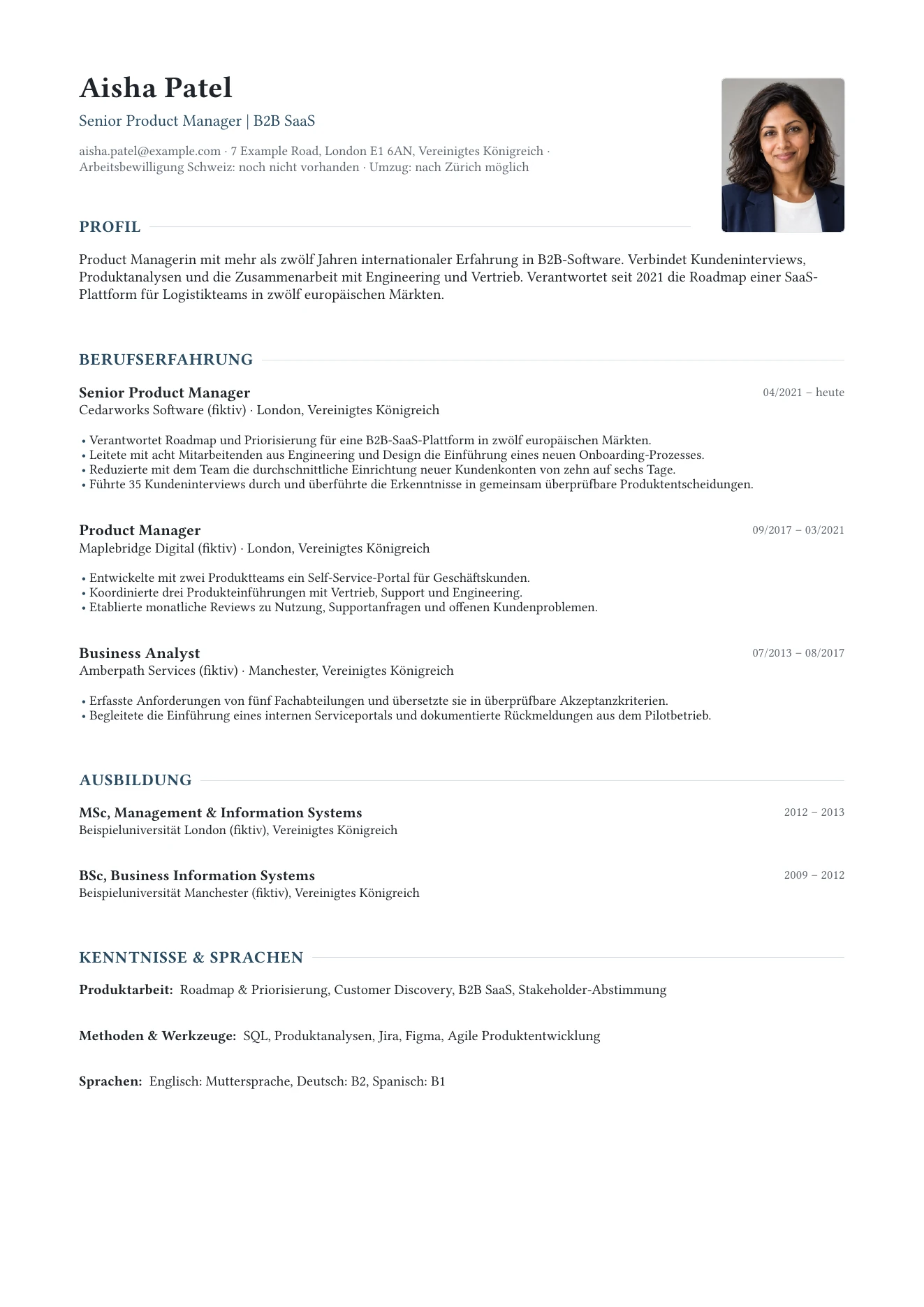
Aisha’s fictional CV covers three roles in Manchester and London and a planned move to Zurich. Use the structure as a starting point and replace the entries with your own experience.
Read the complete text
Aisha Patel Senior Product Manager | B2B SaaS aisha.patel@example.com 7 Example Road, London E1 6AN, Vereinigtes Königreich Arbeitsbewilligung Schweiz: noch nicht vorhanden Umzug: nach Zürich möglich
PROFIL Product Managerin mit mehr als zwölf Jahren internationaler Erfahrung in B2B-Software. Verbindet Kundeninterviews, Produktanalysen und die Zusammenarbeit mit Engineering und Vertrieb. Verantwortet seit 2021 die Roadmap einer SaaS-Plattform für Logistikteams in zwölf europäischen Märkten.
BERUFSERFAHRUNG 04/2021 - heute | Senior Product Manager Cedarworks Software (fiktiv) | London, Vereinigtes Königreich • Verantwortet Roadmap und Priorisierung für eine B2B-SaaS-Plattform in zwölf europäischen Märkten. • Leitete mit acht Mitarbeitenden aus Engineering und Design die Einführung eines neuen Onboarding-Prozesses. • Reduzierte mit dem Team die durchschnittliche Einrichtung neuer Kundenkonten von zehn auf sechs Tage. • Führte 35 Kundeninterviews durch und überführte die Erkenntnisse in gemeinsam überprüfbare Produktentscheidungen.
09/2017 - 03/2021 | Product Manager Maplebridge Digital (fiktiv) | London, Vereinigtes Königreich • Entwickelte mit zwei Produktteams ein Self-Service-Portal für Geschäftskunden. • Koordinierte drei Produkteinführungen mit Vertrieb, Support und Engineering. • Etablierte monatliche Reviews zu Nutzung, Supportanfragen und offenen Kundenproblemen.
07/2013 - 08/2017 | Business Analyst Amberpath Services (fiktiv) | Manchester, Vereinigtes Königreich • Erfasste Anforderungen von fünf Fachabteilungen und übersetzte sie in überprüfbare Akzeptanzkriterien. • Begleitete die Einführung eines internen Serviceportals und dokumentierte Rückmeldungen aus dem Pilotbetrieb.
AUSBILDUNG 2012 - 2013 | MSc, Management & Information Systems Beispieluniversität London (fiktiv), Vereinigtes Königreich
2009 - 2012 | BSc, Business Information Systems Beispieluniversität Manchester (fiktiv), Vereinigtes Königreich
KENNTNISSE & SPRACHEN Produktarbeit: Roadmap & Priorisierung, Customer Discovery, B2B SaaS, Stakeholder-Abstimmung Methoden & Werkzeuge: SQL, Produktanalysen, Jira, Figma, Agile Produktentwicklung Sprachen: Englisch: Muttersprache, Deutsch: B2, Spanisch: B1
Swiss CV template: use this structure
The fictional sample shows a complete CV with twelve years of product experience. Download the editable text file and replace the details with your own. The University of Basel recommends sections by topic, with the most recent entries first.
Choose an order that suits your background. After several years in work, relevant employment usually needs more space. If education is still your main experience, it can appear earlier. Make the experience that matters for this role easy to find.
- Contact: your name and contact details, checked before sending.
- Brief profile, where useful: direction and relevant experience, not a list of adjectives.
- Employment and projects: dates, role, context and specific responsibilities.
- Education and training: relevant qualifications with an accurate completion status.
- Languages and professional skills: understandable descriptions rather than decorative scales.
- Other relevant activities: include them with a clear connection to the application.
Sources and context [5]
How long should a Swiss CV be?
The recommendations differ: Basel suggests no more than two pages, while UZH allows two to three. These are guidelines, not a universal obligation. Specialist profiles and explicit employer instructions can call for something different.
Remove repetition before reducing readability. An older job can be more compact than a recent relevant project. Keep accurate dates and explain the actual work instead of inventing positions to disguise gaps.
Describe your part in a project
Aisha’s example names eight engineering and design colleagues and a reduction in account setup time from ten to six days. Those details explain her work on the onboarding process. Look for details from your own work when editing your CV.
Every task does not need a metric. You can explain the enquiries you handled, procedures you documented or decisions you helped prepare. Leave out figures you cannot confirm.
Photo, format and final checks
The dedicated photo guide below covers the photo decision. Keep that question separate from whether your experience is clearly presented.
Our technical self-check: open the exported file on a second device, select some text and check its order when copied. This is not an ATS certificate; it is a basic check for display and text problems. Also review every field extracted by the employer's portal.
Make a CV bullet more specific
Fictional software-development example. It illustrates wording, not a real person or a measured application outcome.
Too general
Backend development, teamwork, databases.
More specific
Implemented REST endpoints for order management, validated inputs and documented the PostgreSQL data model; coordinated changes through team code reviews.
Revise your existing CV in DraftApply
Bring an existing file
The current Swiss CV workflow begins with an existing CV. Starting without one is still marked Coming Soon.
Check the extracted information
Review the imported content before continuing. Do not carry incorrect names, dates or omitted responsibilities into your next draft.
Edit in the studio
Work with content blocks, the document preview and the existing CV tools. Keep track of what you have changed.
Align it with the application
Use the reviewed version for a specific application. Your CV, letter and portal answers should describe the same real experience.
Mistakes you can catch before sending
Copying a template's claims
A structure can guide you. The responsibilities, qualifications and results must come from your own experience.
Making text tiny to save space
Remove unhelpful repetition first. Check the file at a normal viewing size, not only zoomed in inside the editor.
Confusing a preview with the submitted application
After a substantial change, review the file you will actually use and any portal fields populated from it.
Frequently asked questions
Can I download a Swiss CV template here?
Yes. The fictional German example is available as a PDF and editable text file, and you can copy the text directly. There is no Word download. Editing your own existing CV in DraftApply requires an account.
Can I create a CV from scratch in DraftApply?
Not yet in the current Swiss CV workflow. Use an existing CV as your starting point; the from-scratch option is marked Coming Soon.
Is the template guaranteed to work with every ATS?
No. DraftApply does not promise acceptance by every application system. Check the exported document and review the information extracted by the employer's portal.
Do I need to sign a Swiss CV?
UZH says a signature on a Swiss CV is not customary or expected. The information still needs to be accurate; check any special instructions for your application.
Revise the CV you already have
Upload your CV, check the imported details and edit the text and layout. The preview shows how your changes look in the document.
The CV workflow starts with an existing CV and requires an account for editing. Starting a CV from scratch is not yet available. Plans and usage limits
Text updated:
Sources and context
Sources consulted: 11 September 2026. Prepared with AI assistance using the linked information; not individual recruitment or legal advice.
- [1] arbeit.swiss / SECO – Application tips
Guidance on application documents and preparing a job search.
- [2] University of Zurich – CV
Guidance on length, photographs, language skills and signatures; not a universal employer requirement.
- [3] University of Zurich – Letter of motivation
Role-specific content, length and the differences between a letter and an online form.
- [4] University of Zurich – Attachments
Relevant supporting documents and handling reference contacts.
- [5] University of Basel – Application tips
An alternative CV guideline, including a two-page recommendation and a non-compulsory photograph.
- [6] ETH Zurich – How to apply for a job
Preparing a coherent application dossier and following the requested application channel.
- [7] Workday – Concept: Resume Parsing
A product-specific explanation of how formatting can affect data extraction; not a claim about every ATS or hiring decision.
These sources describe application practice, not DraftApply features. The institutions listed are not presented as partners and do not endorse this product. Examples on these pages are fictional; requirements vary by vacancy.