Switzerland
 Switzerland
Job applications in Switzerland: from vacancy to application dossier
Prepare your Swiss application: understand the requirements, explain international experience, prepare your CV and motivation letter, and check the complete dossier.
No account needed: start with a vacancy and a cover-letter draft.
Aisha’s next application
Senior Product Manager · 12+ years · London → Zurich
Switzerland · Fictional example
Job Fit
Example score
Read the complete text
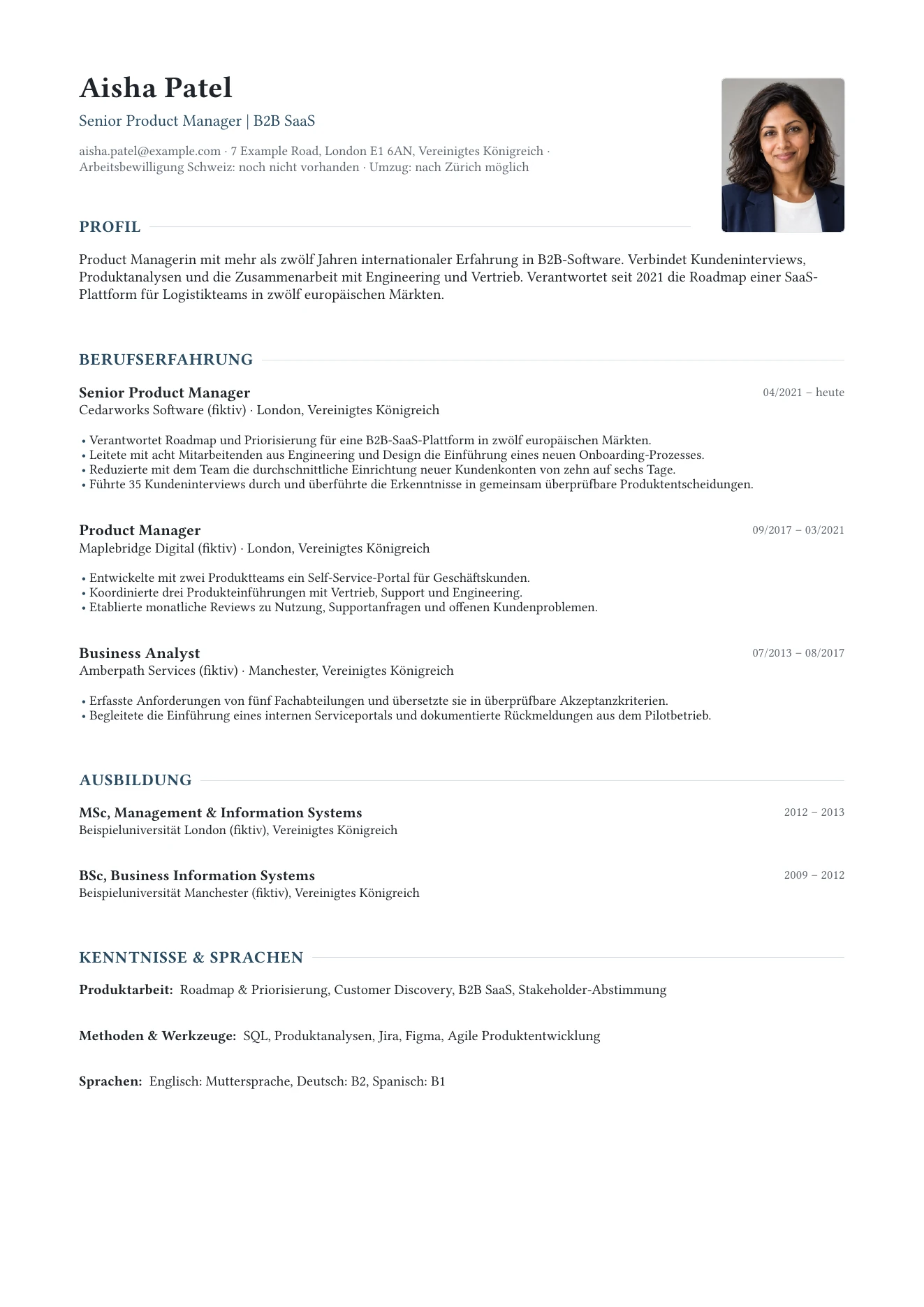
Aisha Patel Senior Product Manager | B2B SaaS aisha.patel@example.com 7 Example Road, London E1 6AN, Vereinigtes Königreich Arbeitsbewilligung Schweiz: noch nicht vorhanden Umzug: nach Zürich möglich
PROFIL Product Managerin mit mehr als zwölf Jahren internationaler Erfahrung in B2B-Software. Verbindet Kundeninterviews, Produktanalysen und die Zusammenarbeit mit Engineering und Vertrieb. Verantwortet seit 2021 die Roadmap einer SaaS-Plattform für Logistikteams in zwölf europäischen Märkten.
BERUFSERFAHRUNG 04/2021 - heute | Senior Product Manager Cedarworks Software (fiktiv) | London, Vereinigtes Königreich • Verantwortet Roadmap und Priorisierung für eine B2B-SaaS-Plattform in zwölf europäischen Märkten. • Leitete mit acht Mitarbeitenden aus Engineering und Design die Einführung eines neuen Onboarding-Prozesses. • Reduzierte mit dem Team die durchschnittliche Einrichtung neuer Kundenkonten von zehn auf sechs Tage. • Führte 35 Kundeninterviews durch und überführte die Erkenntnisse in gemeinsam überprüfbare Produktentscheidungen.
09/2017 - 03/2021 | Product Manager Maplebridge Digital (fiktiv) | London, Vereinigtes Königreich • Entwickelte mit zwei Produktteams ein Self-Service-Portal für Geschäftskunden. • Koordinierte drei Produkteinführungen mit Vertrieb, Support und Engineering. • Etablierte monatliche Reviews zu Nutzung, Supportanfragen und offenen Kundenproblemen.
07/2013 - 08/2017 | Business Analyst Amberpath Services (fiktiv) | Manchester, Vereinigtes Königreich • Erfasste Anforderungen von fünf Fachabteilungen und übersetzte sie in überprüfbare Akzeptanzkriterien. • Begleitete die Einführung eines internen Serviceportals und dokumentierte Rückmeldungen aus dem Pilotbetrieb.
AUSBILDUNG 2012 - 2013 | MSc, Management & Information Systems Beispieluniversität London (fiktiv), Vereinigtes Königreich
2009 - 2012 | BSc, Business Information Systems Beispieluniversität Manchester (fiktiv), Vereinigtes Königreich
KENNTNISSE & SPRACHEN Produktarbeit: Roadmap & Priorisierung, Customer Discovery, B2B SaaS, Stakeholder-Abstimmung Methoden & Werkzeuge: SQL, Produktanalysen, Jira, Figma, Agile Produktentwicklung Sprachen: Englisch: Muttersprache, Deutsch: B2, Spanisch: B1
What belongs in a Swiss application dossier?
As a starting point, arbeit.swiss lists a letter, CV, employment certificates and diplomas. Do not automatically send every file you own: check what this particular vacancy requests.
Check the application language too. The German documents shown here are examples for an application in German. For a vacancy in French, Italian or English, follow the employer’s language instructions. Keep the vacancy with the files you submit.
- CV: the experience you rely on for this application.
- Cover letter or motivation answers: where the process calls for them.
- Evidence: the requested, relevant supporting documents.
Understand the role before writing the application
Pick an important task from the vacancy and find an example of your own. In Aisha’s fictional case, introducing an onboarding process addresses the request for engineering collaboration. Write down what you did and the outcome you can explain.
Record unresolved requirements alongside your examples. Aisha’s German is B2, while the vacancy asks for C1. A high fit score does not answer that language question. Read the reasoning and clarify how essential the requirement is for the work.
- Choose three requirements you can address specifically.
- Write down a verifiable example for each.
- Separate demonstrated experience from learning goals and assumptions.
Your CV and cover letter do different jobs
Your CV organises your background; the letter explains its connection to this role. UZH recommends no more than one page for a separate motivation letter. Online forms have their own field and character limits.
Choose a project that helps explain an important task in the new role. Describe your part in it and how the experience relates to the vacancy. Read the draft aloud and simplify sentences you would not use in conversation.
Sources and context [3]
Check attachments and submission details
For each attachment, ask whether it is requested, relevant and readable. Get permission before sharing a reference person's contact details.
Open the final files yourself and compare them with the vacancy. Use the requested application channel; DraftApply does not automatically submit applications on your behalf. Use the checklist linked below before pressing Send in the employer's portal.
Replace a general claim with an understandable example
Fictional wording example, not a real user's achievement. Only use it if the experience described is true for you.
Too general
I am a team player with excellent organisational skills.
More specific
In my project team, I documented open tasks and coordinated handovers between development and support. I would bring that experience to coordinating your customer projects.
Continue with your own documents
Review an existing CV
Open the Swiss CV workflow, bring your current CV and check the extracted information before continuing.
Bring CV and vacancy together
Use your CV and a specific job in the application workspace as the context for fit review and a cover-letter draft.
Edit the draft
Check names, dates, skills and every claimed achievement. Adapt the wording to your own voice.
Decide and submit yourself
Open the final files once more. Submit them through the channel requested by the employer and keep the confirmation.
Mistakes you can catch before sending
Resending the same dossier without checking it
Review the job title, recipient and required evidence each time. Your previous application is a starting point, not a finished response.
Using AI to fill gaps in your experience
Leave a gap visible or describe a realistic learning step. You will not be able to substantiate invented skills in your own interview.
Treating a tool result as an employer's decision
A fit score and well-worded letter are aids. Review their reasoning rather than relying on a number alone.
Frequently asked questions
Can I use AI to write an application for Switzerland?
You can use DraftApply to prepare and edit a draft. Verify every claim yourself and follow the employer's instructions about using assistance.
Does DraftApply take over the entire application for me?
You work on your documents in DraftApply and review the suggestions yourself. You then submit the application to the employer; DraftApply does not send it automatically.
Do I always need a separate cover letter?
Follow the vacancy and portal. Where the process requests particular documents or motivation answers, an additional generic letter is not automatically useful.
Where do I start with my existing CV?
Use the Swiss CV workflow through Revise an existing CV. Editing requires an account. Starting a CV from scratch is not yet available in that workflow.
Have a vacancy in mind?
Paste the vacancy to preview a first cover letter draft. This preview needs no account and does not use your CV yet. Add your own experience before using the text.
No account needed: start with a vacancy and a cover-letter draft.
Text updated:
Sources and context
Sources consulted: 11 September 2026. Prepared with AI assistance using the linked information; not individual recruitment or legal advice.
- [1] arbeit.swiss / SECO – Application tips
Guidance on application documents and preparing a job search.
- [2] University of Zurich – CV
Guidance on length, photographs, language skills and signatures; not a universal employer requirement.
- [3] University of Zurich – Letter of motivation
Role-specific content, length and the differences between a letter and an online form.
- [4] University of Zurich – Attachments
Relevant supporting documents and handling reference contacts.
- [5] University of Basel – Application tips
An alternative CV guideline, including a two-page recommendation and a non-compulsory photograph.
- [6] ETH Zurich – How to apply for a job
Preparing a coherent application dossier and following the requested application channel.
- [7] Workday – Concept: Resume Parsing
A product-specific explanation of how formatting can affect data extraction; not a claim about every ATS or hiring decision.
These sources describe application practice, not DraftApply features. The institutions listed are not presented as partners and do not endorse this product. Examples on these pages are fictional; requirements vary by vacancy.